Marketing copy system
How Churnkey writes.
Every rule for Churnkey copy, in one place. Read it before you write, then use the checklist before you ship.
01
Churnkey in brief
Churnkey is a retention platform for high-volume subscription businesses. It reduces voluntary churn, when customers cancel. It also reduces involuntary churn, when payments fail.
Who we serve
Self-serve subscription companies on Stripe, Chargebee, Recurly or Braintree. SaaS is the core. Consumer subscriptions are growing.
What sets us apart
Data from 109M+ subscriptions at 1,600+ companies shapes every offer and retry.
Who we write for
Customers, subscribers or users. "Accounts" is sales language, so keep it for bank accounts and billing accounts.
Product names
Product names are proper nouns. Capitalize them everywhere, including alt text, chart labels and customer quotes.
Core
Intelligence Suite
Extend
Related names
Never turn a product into a verb
Don't
We precision-retry failed payments.
Do
Precision Retries made up 66% of all recoveries.
Don't promote Reactivations
Leave it out of feature callouts, product lists and "How Churnkey helps" sections.
02
Voice
Professional but friendly. We write like a sharp colleague who knows the numbers and tells the truth.
Why it matters
People are tired of AI content. Our readers live in Claude Code all day, so they spot it fast. Do the thinking yourself and use your own words wherever you can.
With AI, the bar is so low that good quality content stands out easily. Some humanity in the writing is what gets it there.
Less is more
Write for a smart reader who is busy and not an expert. Make the point, then stop.
Grounded
Back claims with data. Every section should leave the reader knowing what to do next.
Honest
Hedge where the truth needs it. Use always or never only when they are literally true.
Alive
It should feel alive, interesting and fun. Be anything but boring. Research is your friend.
03
Sentences and paragraphs
One idea per sentence
Put a real subject in front of a real verb. Use active voice. Give each stat its own sentence.
Don't
Churnkey recovers up to 89% of failed payments; in 2024, 70% of all involuntary churn detected.
Do
In 2024, Churnkey recovered 70% of the involuntary churn it detected.
Three commas at most
A fourth comma means you have a list. Write a short lead-in and use bullets.
Don't
Retries, dunning, and cancel flows all work directly with the billing information you already have, no separate sync, no duplicate setup, no second source of truth to maintain.
Do
Precision Retries, Dunning Campaigns and Cancel Flows all read the billing data you already have. You get:
- One connection to your billing provider
- One setup for every product
- One source of truth
Say each idea once
This applies across paragraphs and sections too. If a section feels thin, research more. Length is never the goal.
Don't
An intro that defines churn rate, then a "What is churn rate" section that defines it again.
One idea per paragraph
Start a new paragraph when the idea changes. When in doubt, split.
Do
Cards fail for many reasons. Some are hard declines, such as "Stolen Card," which cannot be retried.
But often, they're soft declines like "Do Not Honor" or "Insufficient Funds" which can usually be recovered without customer intervention.
Across 5M failed subscriptions, Insufficient Funds was the leading cause of payment failures, making up 40.5% of all failures.
Vary the rhythm
Mix short and long sentences. And, But or So can start a sentence now and then.
Cards fail for many reasons.
Some are hard declines, such as "Stolen Card," which cannot be retried.
But often, they're soft declines like "Do Not Honor" or "Insufficient Funds" which can usually be recovered without customer intervention.
Across 5M failed subscriptions, Insufficient Funds was the leading cause of payment failures, making up 40.5% of all failures.
Ask the reader's question
A rhetorical question can voice what the reader is wondering. Don't open an article with one.
Do
Is revenue not growing because it's contracting or churning? Are you losing revenue from existing customers or new customers?
04
Patterns that read as AI
These are the most common rewrites. A regex can't catch most of them, so read for them.
The "X, not Y" contrast
This includes "it's not X, it's Y" and "most teams don't do X, they do Y", in body copy and in headings. Write what it does. Splitting the contrast into two sentences still counts.
Don't
It reveals not just what involuntary churn looks like, but what works to prevent it.
Do
It reveals what works to prevent involuntary churn.
Stacked negations
A run of "not X, not Y, not Z" lists what something isn't. Say what it is.
Don't
No developers, no setup, no waiting.
Do
Churnkey integrates natively with Stripe.
Manufactured insight
In the example below, "Here's what most operators miss" is a manufactured insight. It promises a secret, and the claim is exaggerated. State the point.
Don't
Here's what most operators miss: retries need timing.
Do
Retries work best when they follow the decline code.
Setup and twist
Don't
The math is the easy part. The hard part is getting buy-in.
Do
Getting buy-in takes the most time.
Proverb-style closers
The paragraph already made the point. Cut the closer.
Don't
The advantage lasts only as long as the lock does.
Poetry and forced analogies
Don't
When demand is soft, cost-plus holds the price too high and buyers walk.
Do
Cost-plus pricing ignores demand.
Physical goods in a software sentence
SaaS has no shelves, refills or inventory. Name the software thing.
Don't
Customers come back for a refill.
Do
Customers renew.
Throat-clearing
One exception: "Here is what this guide covers" can lead into intro bullets.
Don't
In today's fast-paced world, churn matters more than ever.
05
Words and symbols to avoid
| Avoid | Use instead |
|---|---|
| — (em dash) | A comma, a colon or a new sentence |
| ! (exclamation mark) | Nothing. Let the words carry the energy. |
| fit, fits, fitting | works, suits, makes sense, belongs |
| leak, leaking | lost revenue, revenue you can recover |
| land, lands, landing (as slang) | reaches the inbox, takes a few weeks, sits |
| accounts (for customers) | customers, subscribers, users |
| bundling (shortened keyword) | price bundling. Use the full phrase people search. |
| always, never, every (when untrue) | often, most, many |
06
Casing and punctuation
Everything is sentence case. Capitalize the first word, proper nouns and product names. The element decides the ending.
Link one word at most
Don't
Retries often recover the most, and it's because soft declines can be retried without the customer.
Do
Use tools to create these retention graphs.
| Element | Ends with | Example |
|---|---|---|
| Hero headline, tagline | Period, or ? for a question | Recover more revenue on autopilot. |
| Standalone CTA block, callout | Period | Keep more of the customers you win. |
| H1 and SEO title | Nothing. Use a colon only in blog titles. | Discount pricing: 3 types, risks, and smarter alternatives |
| Section heading (H2, H3) | Nothing. No colons. | Common questions |
| Button, nav, UI label | Nothing | Start free trial |
| Bullet | Period only if it is a full sentence | Segmented email and SMS |
07
Numbers and sources
Churnkey has real data. If you can't source a claim, don't write it.
Never guess a number or a cause
Pull it from the data. If there is no source, cut the claim.
Don't
Involuntary churn usually comes from expired cards.
Do
Insufficient funds causes 40.5% of failed payments.
Link every external stat to its source
Link the number itself. Churnkey benchmarks carry the caption "Based on Churnkey's accounts" instead of a link.
Fix a wrong source before you delete a stat
A good number is worth keeping. Find the real source and credit it.
Translate percentages into dollars
Do
At $10M in revenue and 38% annual churn, involuntary churn costs $836,000 a year.
Approved Churnkey figures
For any other number, use the verified facts library in skynet (growth/marketing/content/verified-facts.md). Only facts Rob has marked verified can ship.
| Figure | How to use it |
|---|---|
| 20 to 40% of the revenue you would otherwise lose to churn | Site-wide claim. Leave it unqualified. Adding "at cancellation" hides Payment Recovery. |
| Up to 89% of failed payments recovered | Always "up to". Never pair it with an average on the same page. |
| 70% of detected involuntary churn recovered | Give the year: 2024. |
| 4% more failed payments recovered, 0.7 days faster | Precision Retries layered on Stripe Retries. Source |
| Involuntary churn is 22% of SaaS churn | 24% in B2C and 16% in B2B. Source |
| More than 109 million subscriptions analyzed | Data credibility. Pair it with 1,600+ companies across 22 industries. |
| $2.3 billion in combined monthly recurring revenue | Data credibility |
Churnkey Lab data
Tables and charts from our research, grouped by product. Each one renders as it does on the site and links to its source.
Churn benchmarks
Free Churn Metrics
Churn rates by industry ⌄
| Industry | Monthly churn* | Annual churn |
|---|---|---|
| Travel and lodging | 4.70% | 43% |
| Business services | 4.20% | 40% |
| Education | 4.20% | 40% |
| Merchandise | 4.10% | 39% |
| Digital goods | 4.00% | 38% |
| SaaS | 4.00% | 38% |
| Insurance | 3.90% | 37% |
| Personal services | 3.70% | 36% |
| Leisure | 3.70% | 36% |
Involuntary churn by industry ⌄
| Industry | Total annual churn rate | Annual involuntary churn rate | Involuntary churn as a % of total churn |
|---|---|---|---|
| Digital goods | 38% | 11% | 29% |
| Business services | 40% | 10% | 26% |
| Personal services | 36% | 9% | 25% |
| Education | 40% | 10% | 24% |
| Merchandise | 39% | 9% | 23% |
| SaaS | 38% | 8% | 22% |
| Travel and lodging | 43% | 8% | 18% |
| Leisure | 36% | 6% | 17% |
| Insurance | 37% | 3% | 9% |
Voluntary churn by industry ⌄
| Industry | Total annual churn rate | Annual voluntary churn rate | Voluntary churn as a % of total churn |
|---|---|---|---|
| Travel and lodging | 43% | 35% | 82% |
| Business services | 40% | 30% | 74% |
| Education | 40% | 30% | 76% |
| Merchandise | 39% | 30% | 77% |
| Digital goods | 38% | 27% | 71% |
| SaaS | 38% | 29% | 78% |
| Insurance | 37% | 33% | 91% |
| Personal services | 36% | 27% | 75% |
| Leisure | 36% | 30% | 83% |
Churn rates, B2C vs B2B ⌄
| Business model | Monthly churn rate | Annual churn rate |
|---|---|---|
| B2C | 4% | 39% |
| B2B | 3.82% | 38% |
Involuntary churn, B2C vs B2B ⌄
| Business model | Annual churn rate | Annual involuntary churn rate | Involuntary churn as a % of overall churn |
|---|---|---|---|
| B2C | 39% | 9% | 24% |
| B2B | 38% | 6% | 16% |
Voluntary churn, B2C vs B2B ⌄
| Business model | Annual churn rate | Annual voluntary churn rate | Voluntary churn as a % of overall churn |
|---|---|---|---|
| B2C | 39% | 29% | 76% |
| B2B | 38% | 32% | 84% |
Involuntary churn by price point ⌄
| Average order value | Annual churn rate | Involuntary churn rate | Involuntary churn as a % of total churn |
|---|---|---|---|
| Less than $10 | 40% | 14% | 35% |
| Between $10 and $30 | 37% | 9% | 23% |
| Between $30 and $100 | 34% | 9% | 26% |
| Between $100 and $1,000 | 30% | 6% | 19% |
| Between $1,000 and $10,000 | 24% | 4% | 15% |
| Greater than $10,000 | 15% | 4% | 24% |
Voluntary churn by price point ⌄
| Average order value | Annual churn rate | Voluntary churn rate | Voluntary churn as a % of total churn |
|---|---|---|---|
| Less than $10 | 40% | 26% | 65% |
| Between $10 and $30 | 37% | 28% | 77% |
| Between $30 and $100 | 34% | 25% | 74% |
| Between $100 and $1,000 | 30% | 24% | 81% |
| Between $1,000 and $10,000 | 24% | 20% | 85% |
| Greater than $10,000 | 15% | 11% | 76% |
Involuntary share of churn by SaaS category ⌄
- AI tools16%
- Marketing tools22%
- Creative tools13%
- Developer tools22%
- Productivity tools21%
- Operations tools17%
Source: Churnkey
Voluntary share of churn by SaaS category ⌄
- AI tools84.10%
- Marketing tools78.24%
- Creative tools87.39%
- Developer tools77.55%
- Productivity tools79.44%
- Operations tools82.75%
Source: Churnkey
Monthly churn rate in 2024 ⌄
| Month | Total churn rate | Voluntary churn rate | Involuntary churn rate |
|---|---|---|---|
| Jan | 9.63% | 7.14% | 0.74% |
| Feb | 9.44% | 7.16% | 0.45% |
| Mar | 9.59% | 7.15% | 0.62% |
| Apr | 8.55% | 6.725% | 0.48% |
| May | 9.44% | 7.31% | 0.64% |
| Jun | 9.505% | 7.07% | 0.535% |
| Jul | 9.845% | 7.105% | 0.965% |
| Aug | 9.465% | 6.815% | 1.315% |
| Sep | 9.69% | 6.52% | 1.28% |
| Oct | 9.98% | 7.105% | 1.05% |
| Nov | 9.64% | 7.24% | 0.92% |
| Dec | 9.73% | 7.035% | 0.83% |
Monthly churn by customer tenure ⌄
- < 3 months12.00%
- 3-6 months7.40%
- 9-12 months4.90%
- 12+ months3.20%
Source: Churnkey
Net revenue retention for bottom-up SaaS ⌄
| Benchmark Source | Bottom Up SaaS NRR |
|---|---|
| Lennys Benchmarks | 100% is good |
| Churnkey Averages | 107–116% is standard |
Consumer churn range by ARR ⌄
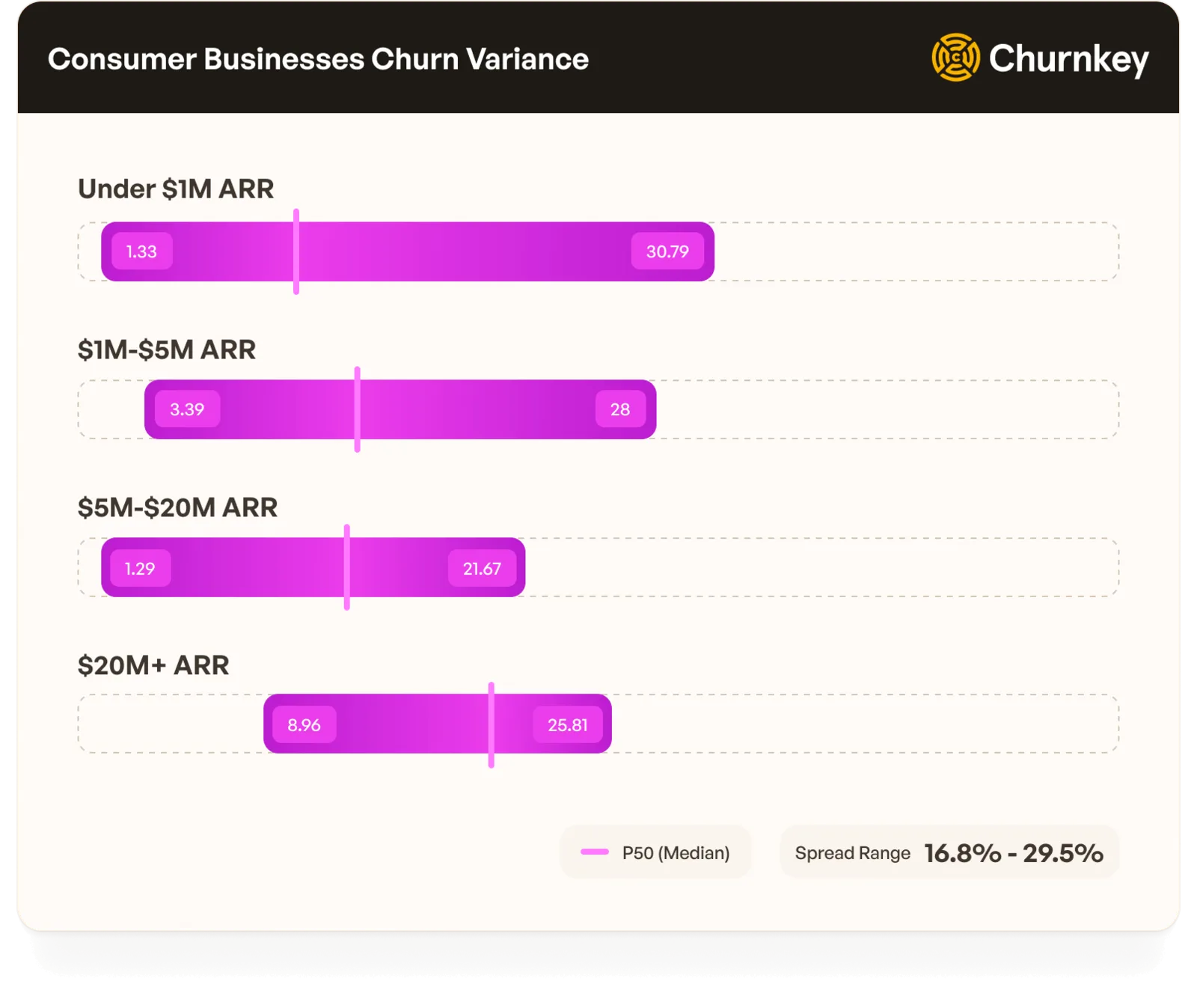
Cancel Flows and offers
Cancel Flows, Adaptive Offers, Feedback AI
Why customers cancel, 2023 vs 2024 ⌄
| Cancellation reason | 2023 | 2024 |
|---|---|---|
| Budget Limitations | 35.1% | 32.97% |
| Infrequent Usage | 27.1% | 30.6% |
| Other Reasons | 16.43% | 17.85% |
| Expectations Not Met | 11.05% | 8.63% |
| Alternative Solution | 4.66% | 4.28% |
| Technical Issues | 3.61% | 4.69% |
| Usability Challenges | 2.06% | 0.98% |
Share of accepted offers by type ⌄
- Discount subscription62.49%
- Pause subscription22.32%
- Change plan7.72%
- Extend trial7.47%
Source: Churnkey
Offer impact on lifetime value ⌄
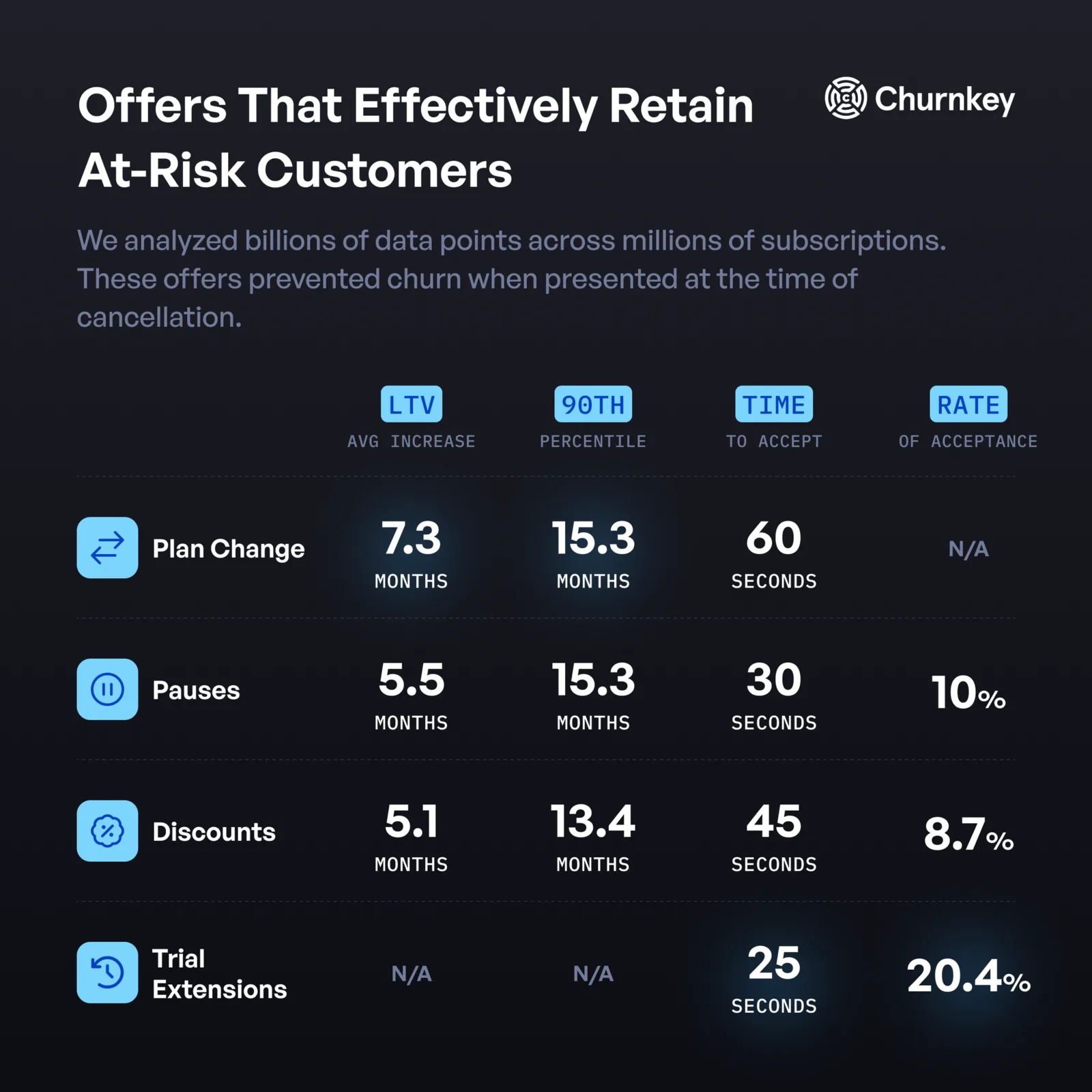
Trial extension benchmarks ⌄
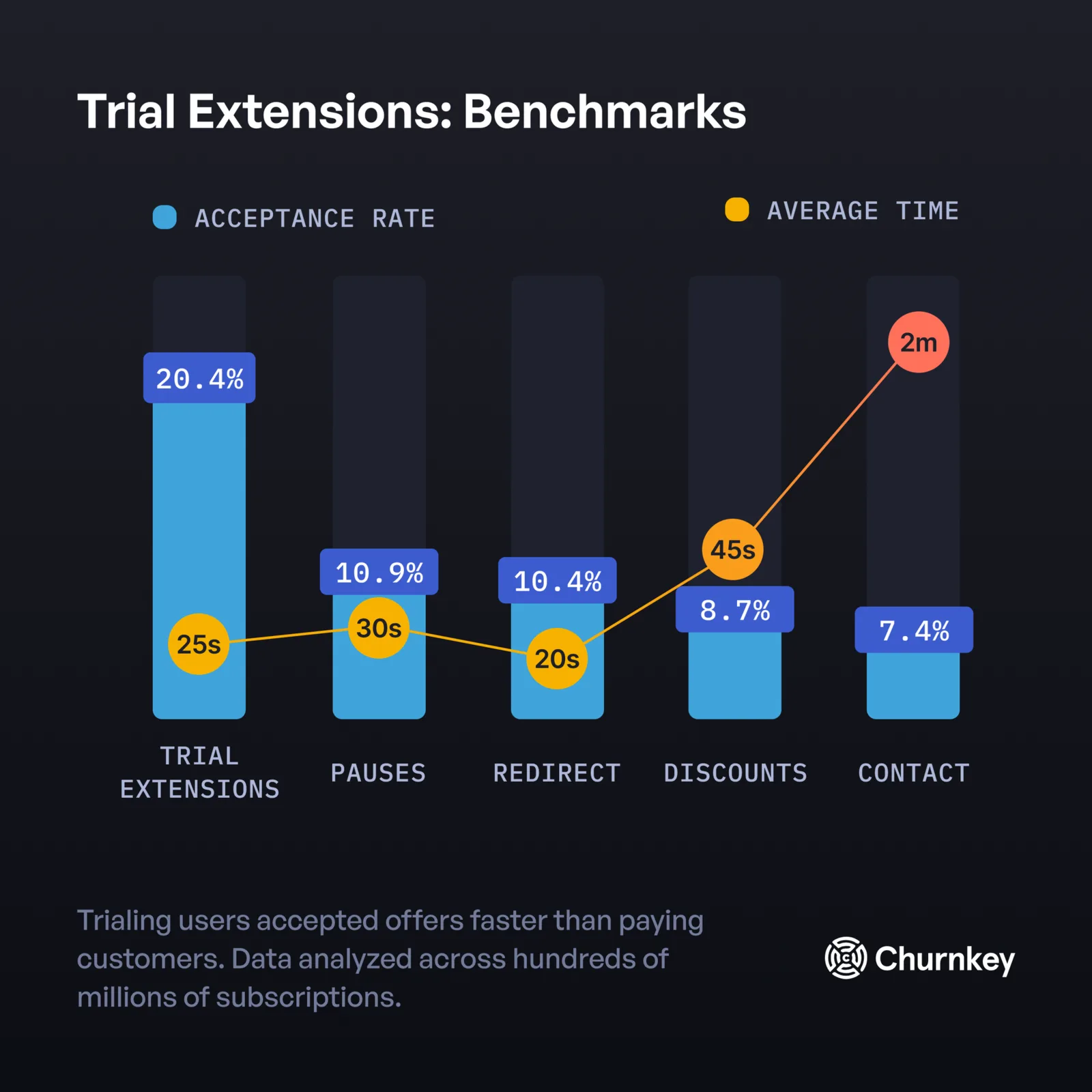
Most accepted discount rate ⌄
- 20% discount2.40%
- 25% discount3.30%
- 30% discount4.10%
- 40% discount8.70%
- 50% discount7.00%
- 100% discount19.60%
Source: Churnkey
Pause acceptance by customer tenure ⌄
- 0 months5.4%
- 1 month10.2%
- 2 months13.0%
- 3 months14.3%
- 4 months14.8%
- 5 months15.3%
- 6 months15.7%
- 7 months16.0%
- 8 months16.2%
- 9 months16.6%
- 10 months16.9%
- 11 months16.8%
- 12 months16.1%
Source: Churnkey
Payment Recovery
Precision Retries, Dunning Campaigns, Payment Recovery Wall
Decline codes by share of failed payments ⌄
| Decline code | Percentage |
|---|---|
| Insufficient funds | 40.56% |
| Transaction not allowed | 8.83% |
| Highest risk level | 7.99% |
| Do not honor | 7.56% |
| Previously declined do not retry | 6.44% |
| Generic decline | 5.78% |
| Incorrect number | 4.69% |
| Try again later | 4.13% |
| Unfurl all | |
| Partner insufficient funds | 3.68% |
| Invalid account | 2.71% |
| Expired card | 1.14% |
| Card velocity exceeded | 1.05% |
| Pickup card | 0.94% |
| Lost card | 0.78% |
| Stolen card | 0.72% |
| Paypal payment declined | 0.45% |
| Link connection closed | 0.42% |
| Cashapp customer request expired | 0.41% |
| Incorrect CVC | 0.39% |
| Blocklist | 0.37% |
| Cashapp payment declined | 0.32% |
| Revocation of authorization | 0.20% |
| Processing error | 0.19% |
| Requested block on incorrect zip | 0.14% |
| Invalid amount | 0.11% |
Precision Retries on top of Stripe Retries ⌄
| Payment Recovery | Average Days to Recovery | |
|---|---|---|
| Only Stripe Retries | 51% | 5.5 |
| Churnkey Precision Retries + Stripe Retries | 55% | 4.8 |
| Improvement | +4% more recovered | 0.7 days faster |
Dunning email performance by email ⌄
| Days | Recovery % | Open % | Click % |
|---|---|---|---|
| Dunning email 1 | 2.8% | 55.8% | 7.1% |
| Dunning email 2 | 1.9% | 48% | 3.2% |
| Dunning email 3 | 1.7% | 39.7% | 4.2% |
| Dunning email 4 | 1.5% | 29.8% | 3.2% |
| Dunning email 5 | 1.5% | 20.6% | 2.9% |
How failed payments were recovered ⌄
| Recovery method | Share of recoveries |
|---|---|
| Precision Retries | 28.1% |
| 8.4% | |
| SMS | 0.6% |
| Failed Payment Wall | 3.5% |
| Billing Contact API | 10% |
Top decline reasons by country ⌄
| Decline reason | US | Australia | UK | India | Germany |
|---|---|---|---|---|---|
| Insufficient funds | 50.1% | 81.4% | 66% | 4.8% | 62% |
| Do not honor | 12.6% | 4.6% | 7.3% | 24.7% | 11.3% |
| Highest risk level | 20.8% | 3.9% | 0% | 6% | 0% |
| Transaction not allowed | 10.2% | 0% | 12.3% | 62.2% | 10.3% |
08
Quotes
- Quote word for word. Never trim or alter a quote.
- Show the quote and one attribution. Don't name the speaker in the sentence before it.
- Give each blog article its own quote. Never reuse one from another article.
- Prefer founders, filings and named analysts over forum posts.
- On use-case pages, quotes must be about retention. Include at least one voice that says churn is solvable.
- Articles use expert quotes. Use customer testimonials only when asked.
Format
"The quote goes here, word for word."
09
Partners, competitors and examples
Partners
Stripe, Chargebee, Paddle, Braintree, Maxio
Frame Churnkey as working alongside them. Never say a partner misses, fails or loses revenue.
Competitors
ProfitWell, Price Intelligently, ChurnBuster, Baremetrics and others
Never name or link them, even to cite data. Paddle's content and data count here too.
Example companies
Notion, Figma, Canva, Linear, Vercel
Choose modern, loved brands. Never HubSpot. Check the company is not a competitor first.
Position Churnkey as a layer on top of a partner
Don't
Churnkey recovers what Stripe misses.
Do
Layering Churnkey's Precision Retries on top captures the additional revenue that might otherwise slip through. On average, together they recover payments 0.7 days faster and get you 4% additional failed invoices.
10
Articles and blogs
Titles match the search and earn the click
Lead with the keyword. Add a number or a hook. Write the title last and shortlist several.
Do
12 tactics to reduce involuntary churn (data from 5.4M failed payments)
Headings open curiosity
Promise a mechanism, a tension or a turn the section pays off.
Don't
Why price bundling works
Do
The science behind why price bundling works
The intro is a hook
Skip the "what is X" summary. The intro must not repeat the first H2.
Lead with the problem
Show the problem with data, then what good looks like, then Churnkey.
Write "How Churnkey helps" fresh for each topic
Pick the capabilities that serve this topic. Cover voluntary and involuntary churn.
Use a source brief for SEO only
Take its keywords, heading structure and FAQ topics. Change its list count and add an item it missed.
Write at least 1,500 words
Earn the length with research. If the competing article is longer, beat it.
Visuals
- Never a wall of text. Mix tables, cards, callouts and pull quotes.
- Every visual supports its section. Cut anything decorative.
- Feature screenshots get no caption. A line that matters goes above the figure as a title.
- Cut captions that hedge or repeat the image.
On dark
Yellow #F7B200 works here
On light
Ink #14110D or blue #1D4ED8
11
Landing and use-case pages
Hero description in two sentences
Open with a benefit or a research-backed hook. Then say what Churnkey does. The H1 names the vertical, so the description shouldn't.
Don't
Churn is quiet. Every renewal is an audit.
Do
Keep more of the revenue your model earned. Churnkey answers the moment a user moves to cancel, recovers payments that quietly fail, and shows you why the rest leave.
Name the churn trigger
Say what actually makes these customers leave, from research. Avoid lines that are true of any product.
Don't
People churn voluntarily through a cancel flow, or involuntarily when a payment fails.
Do
In the off-season, travel operators have fewer bookings and cancel the software they are not using.
Rewrite UI copy to suit the space
Copy inside a cancel flow is read by the customer who is leaving. It must read naturally. Rewrite the whole idea when it runs long, and never cut words to squeeze it into the box.
Don't
More time? Trial ext. avail.
Extend trial 30d, decide later re: plan.
Do
Need more time?
Take another 30 days on us before you decide.
Vary the layout
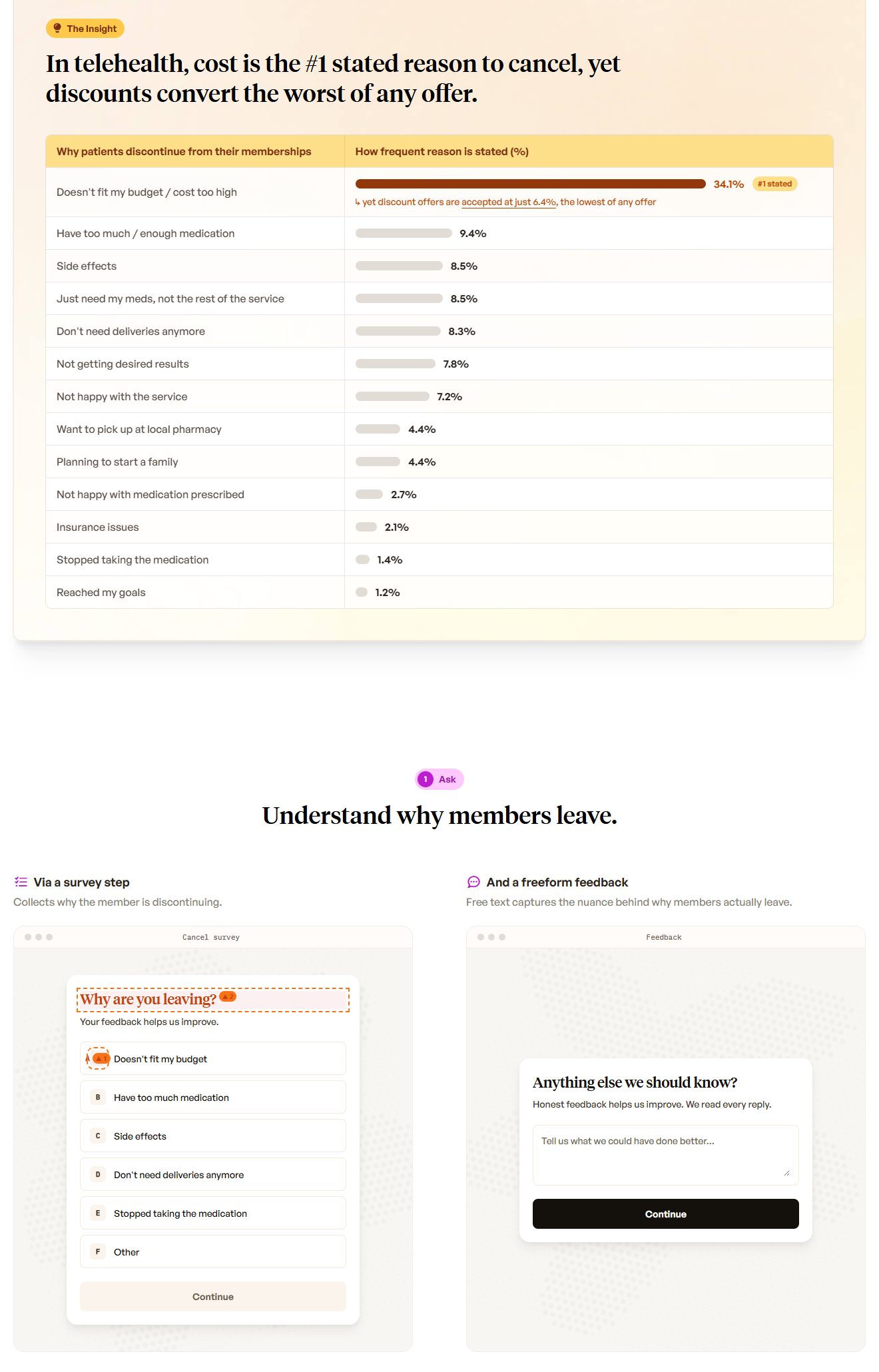
Mix tables, cards, bullets and layouts. Don't overuse one component. Protect negative space. Each example below leans on a different component.
The consumer health page mixes interactive SDK modals, real examples and tables.
12
Before you ship
Run two passes. A search catches the mechanical slips. A careful read catches the rest.
Search for
- Em dashes and exclamation marks
- ", not " and "it's not"
- fit, leak, land, accounts
- Colons in H2 and H3 headings
- Sentences with four or more commas
- Competitor names and links
- Lowercased product names
Read for
- Setups, twists and proverb-style closers
- Poetic phrasing and physical-goods analogies
- Ideas repeated anywhere on the page
- Paragraphs that hold more than one idea
- Sentences that drift from their heading
- Unsourced stats and conflicting figures
- Visuals that are unclear or low contrast
Two tools help. The churnkey-copy-reviewer agent runs both passes on an article. In CI, scripts/validate-articles.mjs fails a build on exclamation marks, Title Case titles and callouts with no period.
Sources
Compiled from app/design-system/copywriting.md, .claude/skills/churnkey-copywriting.md, the khushi-blog-style skill, the how-to-write-articles rules and PR review notes. When a rule changes, update it here too.