
14 Tactics to Reduce Car Wash Membership Churn (With Real Data)
Car wash churn looks like one problem. The data suggests it's actually two, with very different fixes for each. This guide covers 14 tactics and 30 data points on what's actually working.
Most car wash operators we work with run an operationally excellent business. They know their cars-per-hour, their average ticket, their site-level acquisition cost. But solving churn has been a black-box.
This is a guide to fixing that. Most of what's in here came from conversations with the modern car wash POS systems we integrate with directly. The rest comes from the data we see across every car wash customer on Churnkey.
Are you new to Churnkey? We reduce membership churn for best-in-class car wash operators like MRWash and Delta Sonic, integrating directly with payment providers and POS platforms like RollerUp. The tactics and data in this guide come directly from that work.
Voluntary vs. involuntary churn
Voluntary churn is a member choosing to cancel. Involuntary churn (sometimes called passive churn) is a card declining and the member never updating it.
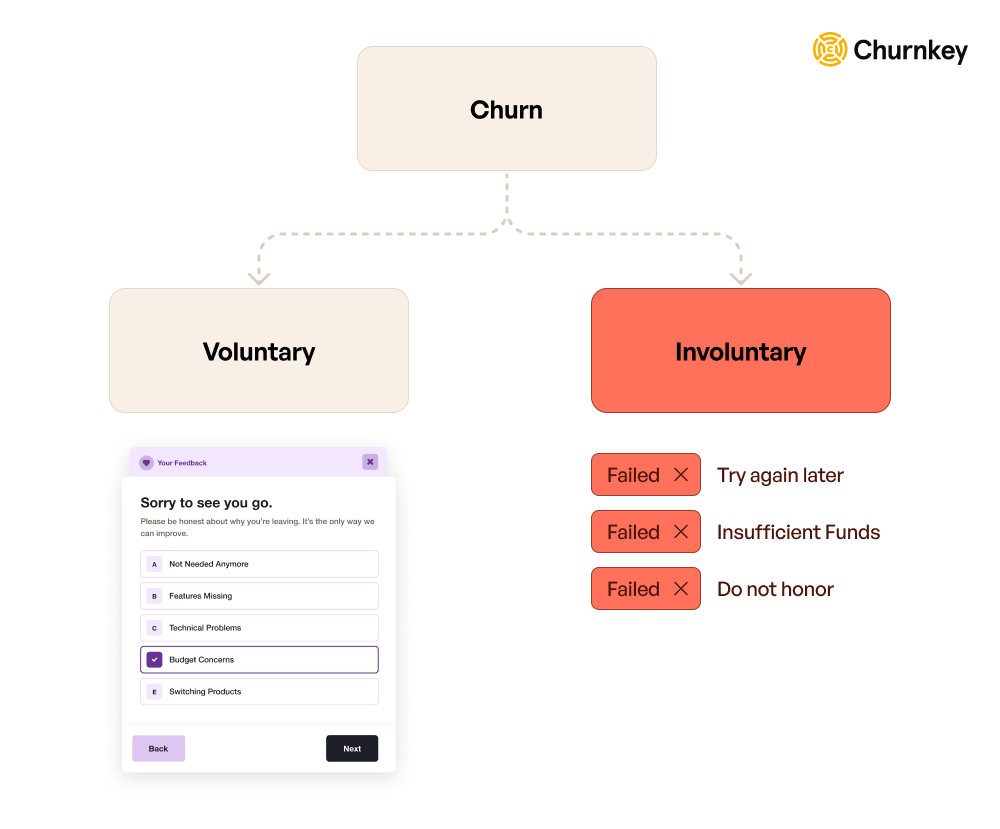
These are two completely different problems with two completely different solutions, and most operators we meet can't tell us their split. One car operator described it as:
"I'm really trying to figure out what our actual involuntary churn is, and I don't think the numbers we have are right."
For a typical car wash, voluntary cancellations are roughly 60% to 70% of monthly churn. For an unlimited wash club running on a monthly wash plan, that's the dominant churn pattern.
Involuntary failed payments are the remaining 30% to 40%. Knowing the split changes what you should be working on this quarter.
Start with involuntary churn. It's the easier win.
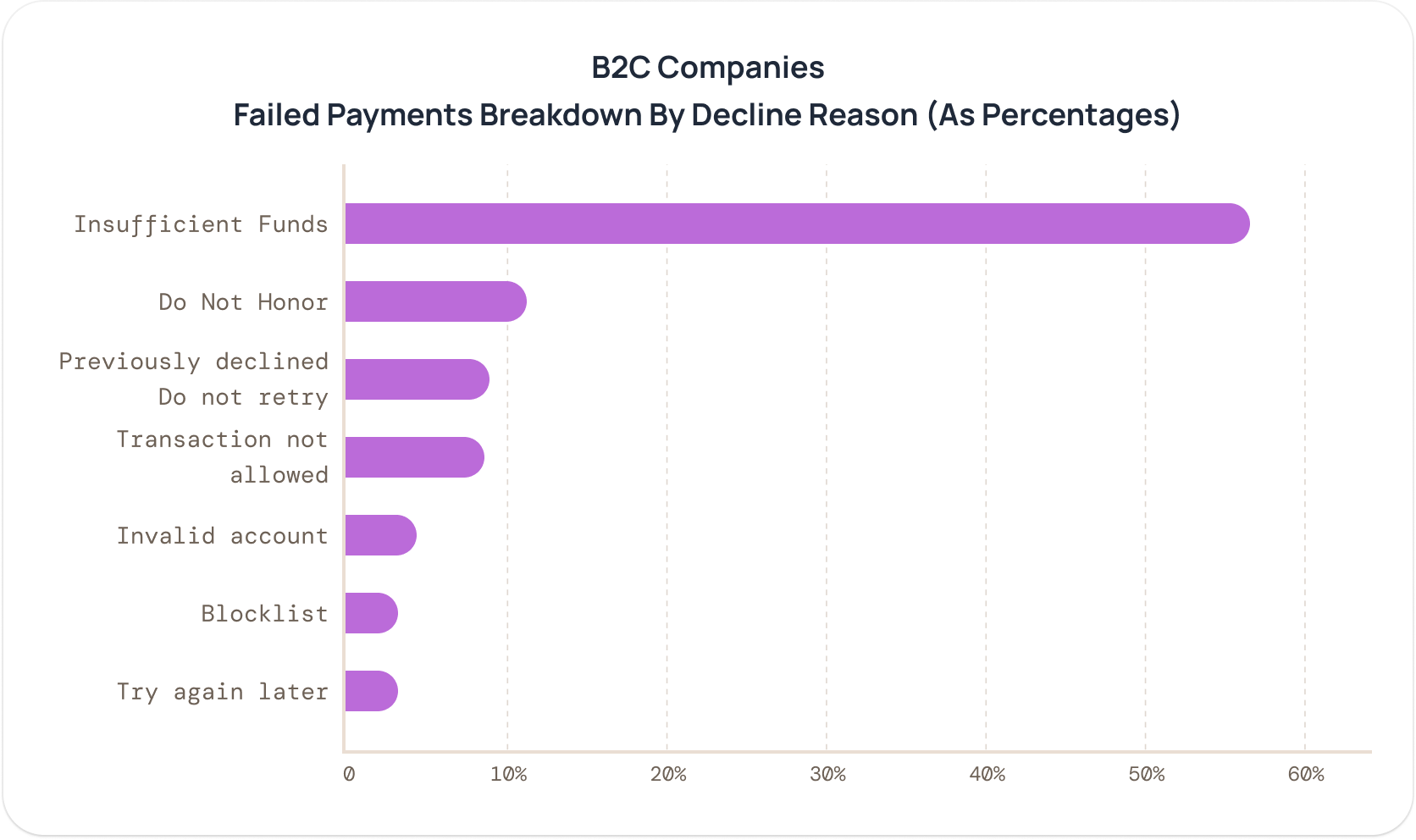
Most car wash members who lose a subscription to a failed card never wanted to cancel. They just changed banks, their card got reissued, or the charge hit on a low-balance day and they never noticed the email.
As one of our industry partners put it:
"Car wash customers are not educated enough when it comes to failed payments."
The standard car wash response is to hammer the card.
"Other car washes just hammer retries for 14 cards in a row."
Brute-force retries get cards flagged as fraud and burn through your processor's retry budget. Both Visa and Mastercard have limits after which there are penalites.
There are lots of people in the system so this needs careful handling.
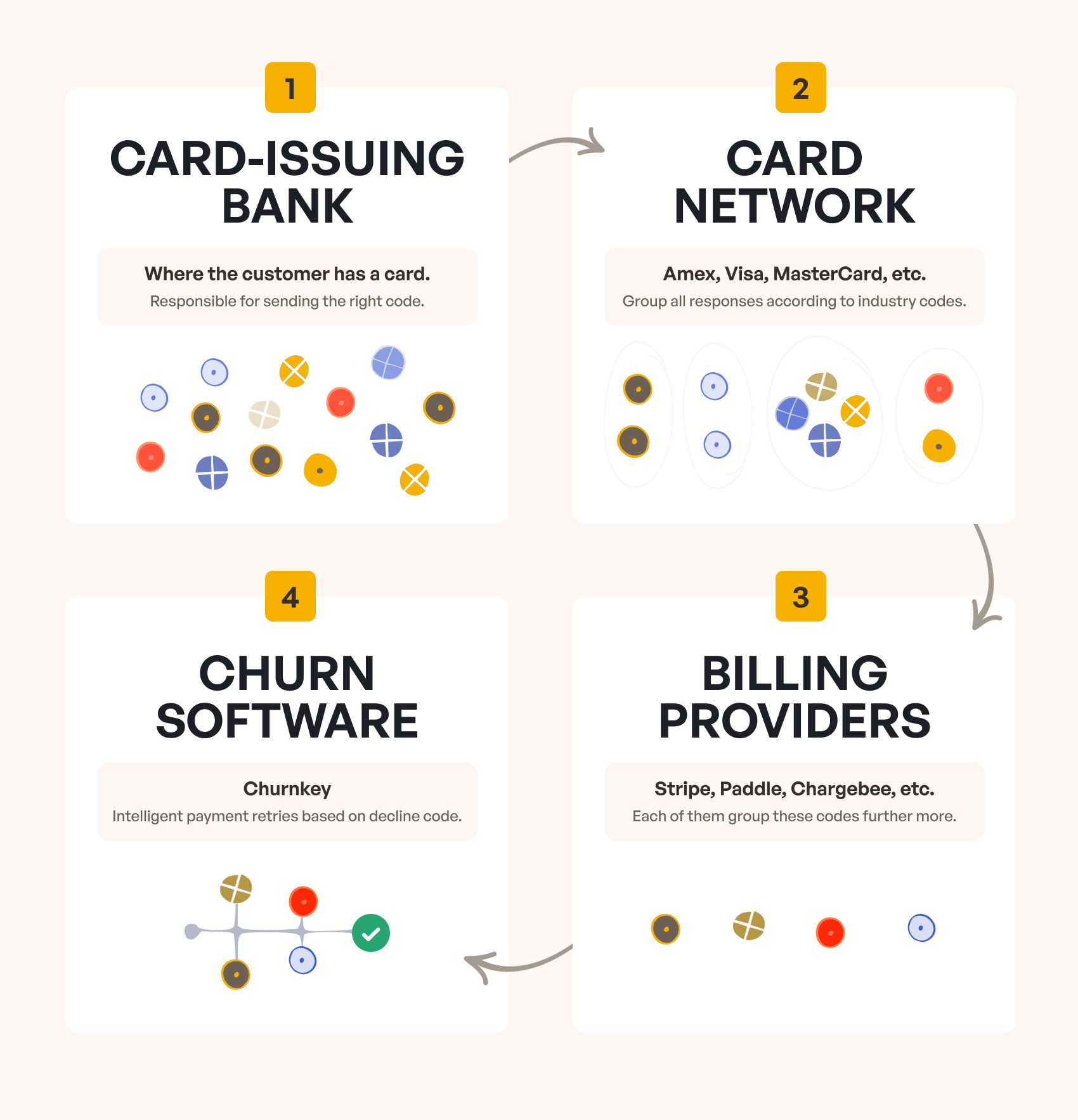
The work is in retrying smarter, not harder. Here's what actually moves the number.
- Retry by decline code, not by schedule.
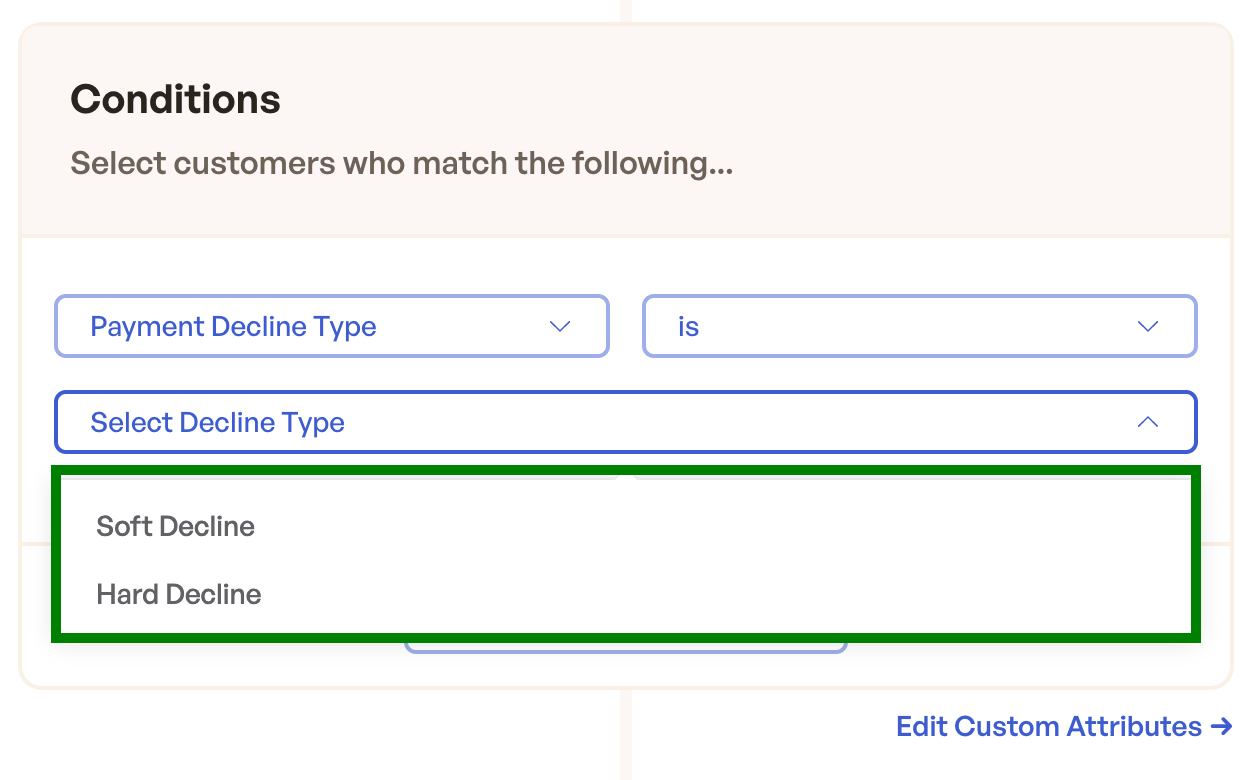
A card declining for insufficient funds is a different problem than a card declining because it expired. Soft declines (try again, insufficient funds, temporary issuer holds) recover with retry timing. Hard declines (expired, lost, stolen) need the customer to physically update their card. Churnkey routes these separately. Most legacy car wash tools don't.
Soft/Hard Decline segmentation is available in Churnkey's Payment Recovery suite of products.
- Retry at the right time of day, in the customer's local time zone.
A 9 a.m. retry succeeds more often than a 3 a.m. retry because issuing banks don't flag morning charges as fraud. Most retries fired blindly by legacy systems happen at whatever time the cron job runs. - Retry across the full pay-cycle window, not the first 14 days.
Most failed-payment recoveries happen in the first two weeks. But the long tail is real. Here's the distribution from our enriched data:
| When recovery happens | Share of recoveries |
|---|---|
| Week 1 (0–7 days) | 61.2% |
| Week 2 (8–14 days) | 11.7% |
| Week 3 (15–21 days) | 8.7% |
| Week 4 (22–28 days) | 6.4% |
| Week 5+ | 12.1% |
Drawn from our enriched charge data at Churnkey's platform scale. The data is directionally relevant; exact percentages will differ for a car wash member base.
Weeks 1 and 2 do roughly 73% of the work. Weeks 3 and 4 do another 15%. If you cut off at 14 days, you're leaving roughly a quarter of recoverable revenue on the table.
One car wash operator noticed this after switching to a 28-day retry window:
"I think SMS and Apple Pay and being able to try for 28 days is huge."
- Use SMS, not just email.
Members may ignore failed-payment emails. They are less likely to ignore texts. Across Churnkey's car wash customers, SMS accounts for 18% of recoveries despite being a much smaller share of attempts. Pair it with a one-click card-update page hosted on your own subdomain, branded as your wash, so the member trusts the link. - Handle Apple Pay properly.
Mobile wallets are a growing share of car wash payments and they retry differently than plain cards. In our broader platform data (SaaS, not car wash), Apple Pay recovers at 49.2% versus 44.4% for plain card. Direction is consistent; magnitude will likely be different in your customer base. Most embedded car wash billing tools don't handle wallet retries at all.
What this looks like in practice, for Mr Wash specifically is that passive churn halved after they switched to Churnkey from their previous retention vendor. Another operator on our platform went from 2% to 1%.
Why half a point matters
"When you hit scale with a couple hundred thousand members, half a percent is a big deal." — Nathan Harris, MrWash
On 100,000 members at $30 a month, half a point of monthly churn is roughly $180,000 a year. On 200,000 members, it's $360,000. For some car wash companies, it's at seven figures. For these car washes, member retention is the lever that matters more than acquisition.
What we've recovered for car washes so far
Since January 2024, we worked with several car washes:
| Metric | Value |
|---|---|
| Invoices recovered | 233,338 |
| Dollars recovered | $6.5M |
| Smart retries share of recoveries | 60% |
| SMS share | 18% |
| Email share | 18% |
| Auto retries share | 4% |
One car wash operator, who tested all of it shared this:
"Your involuntary churn stuff is really helping. I think your most impressive thing is the precision retries, personally. The back-end engine that's getting credit card data back, and the SMS stuff, that's impressive to me."
Now the harder one: voluntary churn
Voluntary cancellations at a car wash is mostly a usage problem. Members who feel they aren't washing enough to justify the cost convince themselves to cancel. Members who wash all the time rarely do.
Most car wash cancel experiences offer one option: cancel. They don't offer a survey, an offer or an option to pause for winter. That means you lose the member who would have stayed with a small adjustment exactly the same way you lose the member who was always going to leave. Worse, you don't learn anything from either of them.
The cancel flow should do four things.
- Know how often the member actually washes.
When a member hits cancel, the experience should know whether they washed 12 times last month or once. That changes everything about what you say next. Pass Churnkey the wash activity as a custom variable and we'll use it both in the messaging the member sees and as a segmentation rule that decides what offer they get. - Treat power users differently from drifters.
A member who washed three times a week and is still cancelling is telling you something about pricing, service, or moving. A discount is the wrong response. A reminder of what they've used, an upgrade conversation, or a "help us understand" question is the right one. For members who barely wash, an aggressive save is usually not a good option. - Offer plan switches, not just discounts.
On most car wash subscription platforms you can't actually issue a discount, but you can move a member to a cheaper tier. Build the save offer around that constraint. A "stay for $5 less" offer that actually executes as a plan change works inside your existing billing setup. - Offer pause for the seasonal members.
A real pause keeps the member in your system. A permanent cancel will not retain these snowbird members. In a winter market, half the members who hit cancel in November would happily pause until April if you asked. - Capture cancellation reason with structure and freeform feedback.
"Dissatisfied with service" tells you nothing. "Moved" vs. "too expensive" vs. "wasn't washing enough" each point at a different fix. Get to specifics by using a short freeform survey, then run free-form responses through Feedback AI to find themes you didn't have in your dropdown.
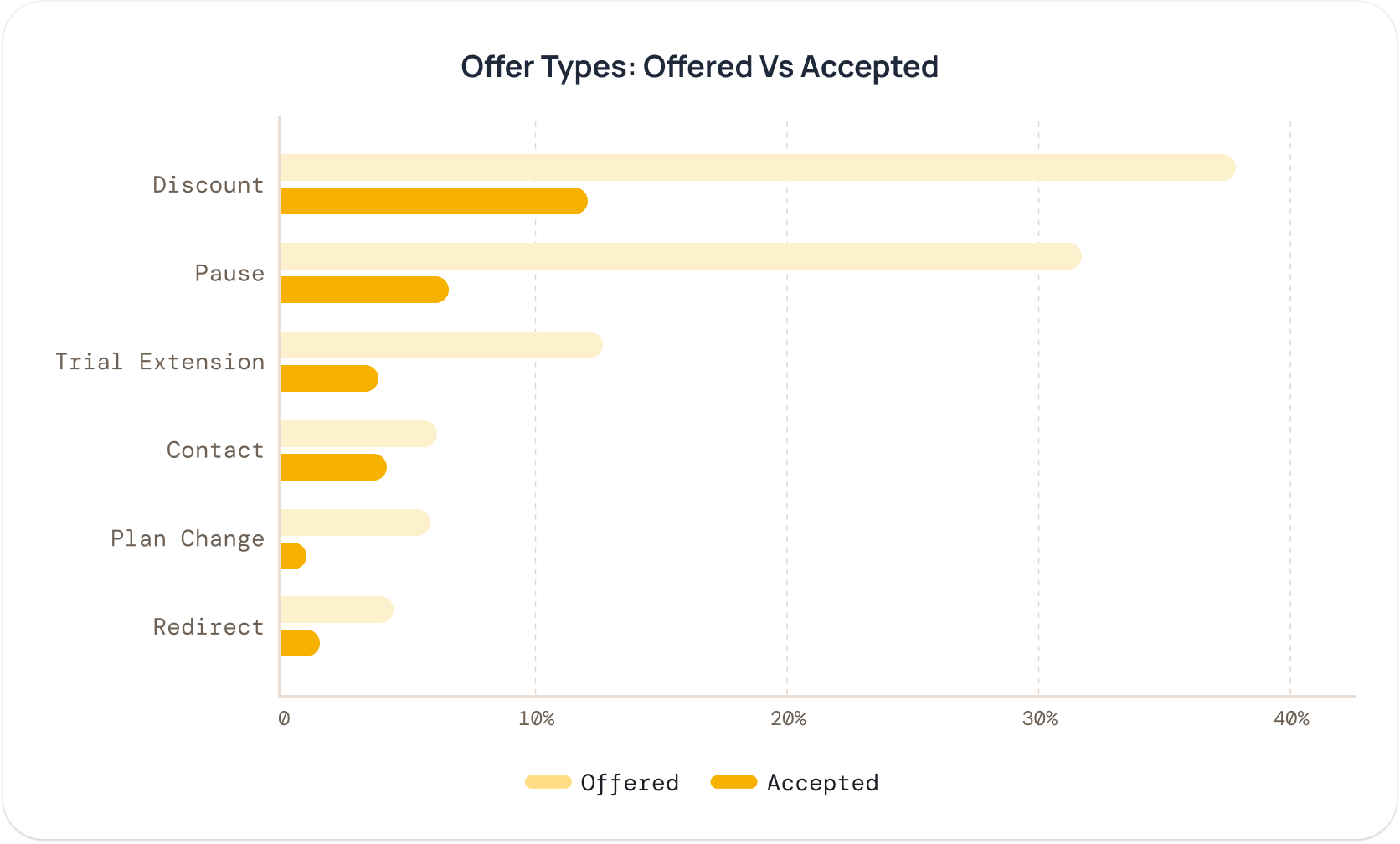
Discounts, pauses, extensions, and may other offer types work, as shown in Churnkey's platform level data below.
Member retention tactics that work outside of Churnkey
Our car operators also runs two tactics that aren't native to Churnkey, but they work. You should try them.
- In-person card updates at the gate.
When a member arrives at the wash and their card is expired, the attendant should be able to capture the new card and run the charge immediately.
"We don't give a grace period to customers. When they come in with an expired plan, we have a note that tells us it's past due. Then we can get the new card added and charged immediately."
For this to work, your POS, your billing, and your member data have to actually talk to each other. If they don't, you're leaving recovery on the table at exactly the moment your members are physically standing in front of you.
- Reactivation emails to lapsed members.
Emails former subscribers and they re-sign on the website. - Look at when your cancellations happen. Car wash operators we've talked to have found that cancellations cluster in specific windows, often 7:30 to 9 p.m. Most operators have never looked at this. If you find a cluster, that's when you want a human or a strong save offer ready.
- Treat your POS as a retention surface, not just a transaction system. Member data, wash activity, cancellation timing, and payment health should live in one place. If your billing data, your member data, and your wash activity data live in three places, you can't run real retention.
Why use Churnkey for car wash membership retention?
You can build some of this yourself. A talented engineering team can build a basic cancel flow in a week.
The hard parts are the ones you can't easily build:
- Decline-code-aware retry logic, trained on more than 700 million billing events across more than 1,000 companies
- A 28-day retry window with timing tuned per local time zone, decline code, and statistical pay-cycle data
- SMS infrastructure with proper deliverability, opt-outs, and bulk pricing
- Apple Pay retry support
- Dunning sequences with rotating sender names so messages don't stack in the inbox
- Branded card-update pages hosted on your own subdomain, pre-populated with previously successful invoices to build trust
- A Payment Recovery Wall that surfaces a past-due balance the next time a member opens your portal or app
- Adaptive Offers, an AI engine that generates and tests coupon variants against your historical data to find the smallest effective save offer
- Cancel flow segmentation by wash activity, tier, tenure, billing interval, or any custom attribute you pass us
- Plan-switch save offers built for car wash billing platforms that don't support traditional discounts
- Pause as a first-class cancel alternative, with configurable durations for seasonal members
- Cancellation surveys with structured follow-up questions, not just an open text box
- Feedback AI that groups free-form cancel responses into themes and ties each theme to a dollar amount of lost revenue
- A/B testing on cancel offers and dunning campaigns with statistical significance built in
- Analytics tying every save and every recovery to a specific dollar amount, broken down by site, plan, decline code, and offer
- A failed-payment activity stream that lets you watch recoveries land in real time
- Account Agent, an AI layer that scans your data and surfaces specific revenue-recovery opportunities you'd otherwise miss
- Reactivation campaigns to win back members who already cancelled
- Direct integrations with Stripe and the modern car wash billing platforms our customers actually use
- .... and so many big little features!
Increasing your LTV is all we research and implement, every single day of the year.
We're already working with car wash operators ranging from single-site tunnels to large multi-site chains. Beyond billing platforms like Stripe, Chargebee, et. al Churnkey has also integrated directly with modern car wash billing platforms our customers use.
FAQs
What's a normal monthly churn rate for car wash memberships?Industry benchmarks vary, anything below 4% is healthy. At 5%, you lose nearly half of all customers you acquire within a year. At 7%, you lose nearly 70% of all customers.
Why do car wash members cancel?
The single most common reason is perceived underuse. Members who feel they aren't washing enough to justify the monthly cost convince themselves to cancel, even when the math still works in their favor. Other common reasons include seasonal slowdown (especially in winter markets), a bad in-tunnel experience, a price increase, or a member who moved out of your service area. Capturing the actual reason at the moment of cancellation, rather than guessing, is the first step to addressing it.
Failed payments (or involuntary churn) makes up 40% of your churn. This is typically accidental cancellations and are easier to recover.
What's the difference between voluntary and involuntary churn at a car wash?
Voluntary churn (sometimes called active churn) is a member choosing to cancel their unlimited wash plan. Involuntary churn (also called passive churn) is a card declining and the member never updating it. They look the same on your dashboard but they need completely different solutions. Voluntary churn is mitigated with smarter cancel flows, save offers, and usage-based engagement. Involuntary churn is mitigated with smart retry timing, dunning campaigns, and one-click card-update flows.
How do I recover failed payments for car wash memberships?
The high-leverage moves are retry by decline code instead of by a fixed schedule, retry across the full 28-day pay cycle instead of cutting off at 14 days, and pair retries with SMS and email dunning that points to a branded one-click card-update page. On average, Churnkey's customers recover 20-40% of the revenue that they would otherwise lose to churn.
Should I offer a pause option instead of forcing members to cancel?
Yes. Pause as a cancel alternative is one of the highest-leverage retention moves a car wash operator can make, especially in winter markets and for snowbird members in Florida, Arizona, and Texas. Configure pauses based on who the customer is, when they asked it, how many washes they experienced.. and so on. You can also use Churnkey's Adaptive Offers to decide on the length of the pause and who to offer it to. All Churnkey offers have anti-abuse built in with cooldown periods.
Does Churnkey work with my car wash POS or billing system?
Churnkey integrates directly with Stripe, Chargebee, Paddle, Recurly, Braintree, and modern car wash POS platforms like RollerUp. If you process payments through one of those, you can be running in days. If your stack is non-standard, we can usually still help, though setup looks different. Please speak to our team.
What does Churnkey cost for a car wash operator?
Pricing is based on your monthly churned revenue volume. There's a 14-day free trial. For a precise quote based on your member count and average plan price, the fastest path is a quick call.
To get started, book a demo or sign up for Churnkey.